Avatar the Last Airbender Behind Scene Featurette Martial Arts
Avatar: The Last Airbender introduced a generation of fans to martial arts, animation and long-form story-telling -- merely what many don't know is that airbending, waterbending, earthbending and firebending aren't merely fantasy. Oh sure, theelement-angle part of them is -- simply the movements are based on existent-life martial arts that anyone can go out and larn.
Revealed through special features included with DVD and Blu-ray releases, as well as through Avatar Extras (a special rerun on Nicktoons where notes from the staff would popular up while the episode played), the team has named each martial fine art the 4 angle forms are based on, giving dedicated fans the perfect opportunity to get more Avatar-like themselves.

In the series, fifty-fifty the more than obscure instances, like when a character has a singled-out or unique way, accept very specific martial arts inspirations. For example, Toph's bending manner is based on the Southern Praying Mantis style, Chu Gar, which perfectly suits her as information technology focuses on keeping one's feet on the footing. Meanwhile, Capoeira, a Brazilian martial art that combines dance and combat, was used for the dancing scene in Season 3, Episode two, "The Headband." Just, of course, information technology'due south easier to catch the styles that get the most screentime.
Baguazhang's English language alias, circle walking, will make its element immediately apparent to whateverAvatar fan. Emphasizing circular motions, this martial art is one of the few that uses weapons, something that Airbenders appear to be unique for amid the four nations, with even Avatar Kyoshi using a fan to aid her airbending techniques.
Much similar the curling wind, the Baguazhang practitioner is almost always moving, emphasizing flexibility in set on and defence, also as agility and constant repositioning to gain the upper paw. These quick, unpredictable movements hateful that they can switch from evasion and blocking to attacking near seamlessly, all while confusing opponents. This perfectly matches the Air Nomads' dual nature of holding perhaps the nighdevastating element (as Zaheer proved) and most pacifistic ideals.
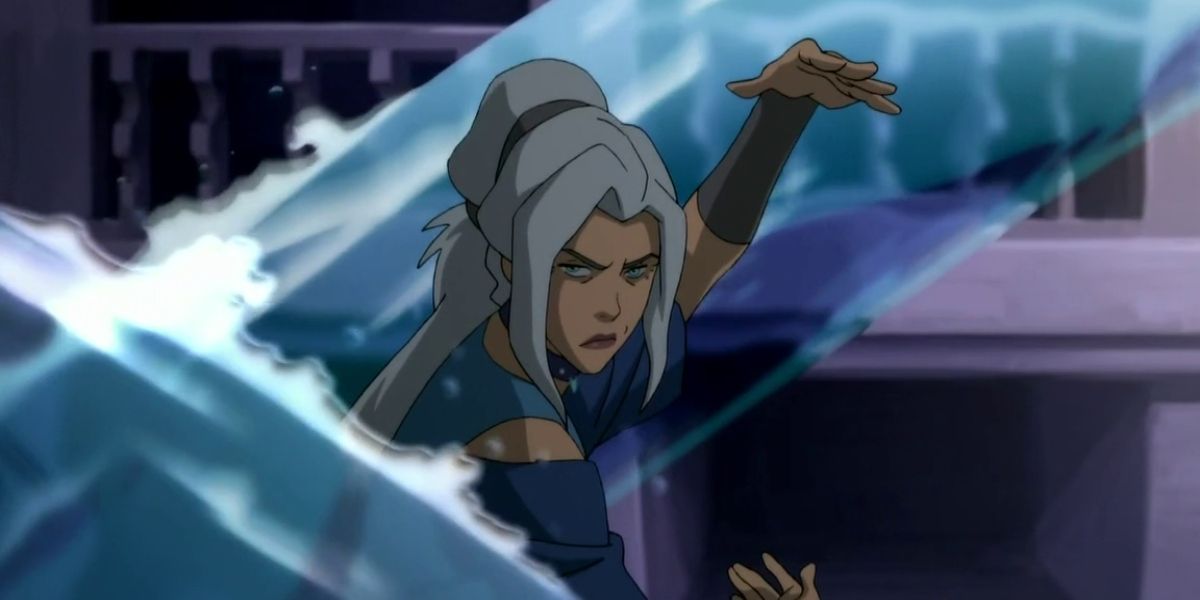
Following the avatar cycle, the element of water is represented by Tàijí Quán, more ordinarily known as Tai Chi. While the connections betwixt this mode's fluid movements and the ebb and flow of the tide is immediately clear, there'south a strength and deliberateness to it that sets it apart from airbending.
Tai Chi is usually used as a grade of do or meditation, merely when applied for a fight, a Tai Chi user can both defend and attack in i fluid motility, like to how an ocean current can pull one away from danger whilst sucking up one'south adversaries. Merely, like learning to travel the loftier seas, Tai Chi requires an incredible amount of dedication to master -- no matter how piece of cake it appears to exist. Thus a Tai Chi practitioner who looks like an piece of cake target may, like a sudden wave, quickly turn the tide of boxing, making the art perfect for the Water Tribe.
Hung Gar Kung Fu is a powerful fighting style with focus on rock-solid stances that made it a no-brainer to correspond the Globe Kingdom'south usual earthbending techniques. While information technology may not emphasize "contact with the ground" as much as the previously mentioned Chu Gar style, its utilise of low, wide forms ensures that Earthbenders are nigh incommunicable to have down.
Dissimilar both Tai Chi and Baguazhang, this class uses sharp, powerful, caput-on attacks perfect for embodying the overwhelming strength of Earthbenders who suffer attacks rather than avert them. It's worth noting though that, while stability is primal to this style, it yet involves a fair amount of footwork, particularly when moving to assault.
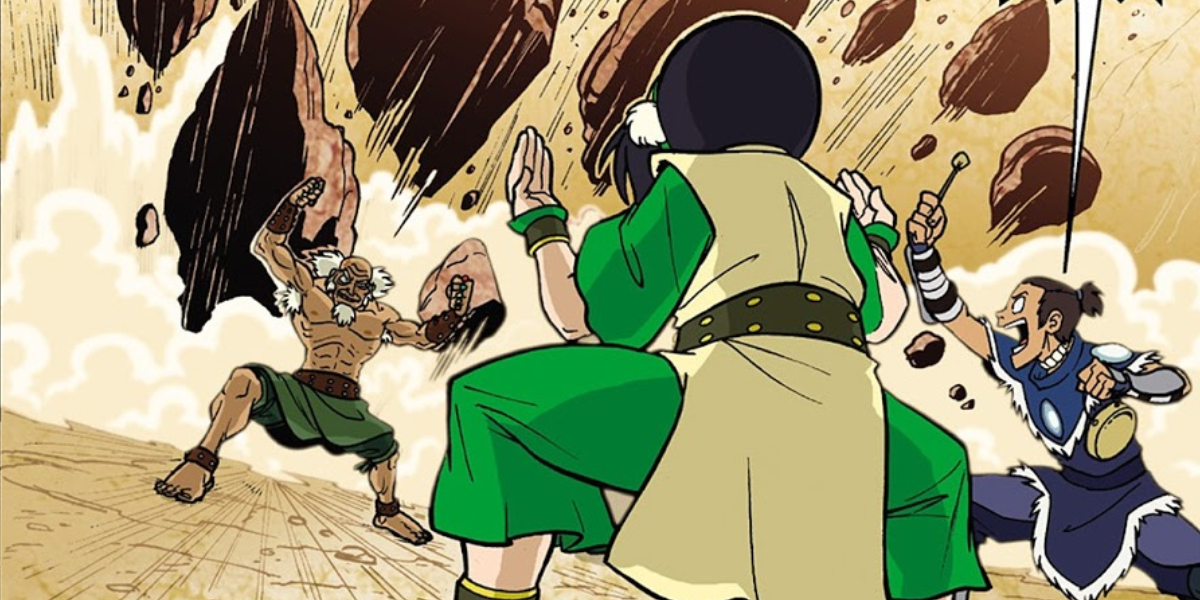
Finally, Northern Shaolin Kung Fu, with its aggressive attacks and sharp forms, was chosen to represent burn. This style employs more jumps, kicks and punches than the other styles, making information technology a more energetic fine art for an energy-based chemical element. The ambitious and primarily offensive nature of the forms makes it a perfect choice for the warlike Fire Nation. While the style has defensive and countering moves as well, subduing an opponent is often the best path to victory.
As a outcome of these quick aggressive moments, Northern Shaolin can announced less controlled than the other forms, which perfectly suits Firebenders who rely on rage and hatred to fuel their flames. In dissimilarity though, really learning to command the grade takes fourth dimension, skill and dedication, making the moves anythingbut emotional outbursts, every bit Zuko and Aang larn in Flavour three, Episode thirteen, "The Firebending Masters."
Each of these different martial arts emphasizes a different attribute of the element they stand for, from Tai Chi's fluidity to Hung Gar's stability, helping the viewer distinguish different benders just by their movements, all while helping create singled-out cultures for each Nation. By studying and putting in the effort needed to accurately capture each style'due south forms into blitheness,Avatar was able to create history for each fight, telling its story in a dynamic way that would non take been possible otherwise.
About The Author

Source: https://www.cbr.com/avatar-the-last-airbender-martial-arts-inspirations-bending-elements/
0 Response to "Avatar the Last Airbender Behind Scene Featurette Martial Arts"
Post a Comment